AFOQT Practice Test
Practise for the AFOQT with 1,000 exam-style questions, an explanation for every answer and stats that show what to study next.
What is the AFOQT?
The Air Force Officer Qualifying Test (AFOQT) is the U.S. Air Force aptitude test used to select applicants for officer commissioning programs, such as Officer Training School and Air Force ROTC, and for pilot and navigator training. It has 12 timed subtests and 516 multiple-choice questions, takes about five hours including breaks, and is free. AFROTC detachment pages list minimum scores of Verbal 15 and Quantitative 10. Before you plan your study, take an AFOQT practice test under the real time limits. The time per item runs from about 10 seconds to more than two minutes depending on the subtest, and the total length does not show that.
This page does not draw on the Air Force's governing manual. The facts here come from Pearson VUE, which delivers the test and names the Air Force as its sponsor, and from three AFROTC detachment pages. Pearson's page was last updated in August 2026, and two of the detachment pages carry 2025 or 2026 dates. Confirm any rule that affects you with your recruiter or test control officer.
Who can take the AFOQT?
Your recruiter or the test control officer at a base education center checks whether you are eligible to take the AFOQT. Pearson VUE says to contact them first, and that they give you the voucher you need to schedule. We could not confirm the Officer Training School rules on age, degree, GPA or citizenship, so ask your recruiter.
AFROTC cadets need passing scores to contract, compete for scholarships and compete in the POC selection process, according to Montana State's detachment, which adds that your Academic Aptitude score is considered in that process. Montana State and Rutgers both say the first attempt is due by the end of your first academic term. Montana State wants passing scores by the end of fall semester in your AS200 (sophomore) year, and Rutgers wants any third attempt finished by the end of fall term in your AS300 (junior) year, so check your own detachment's dates.
USF's detachment says the test is moving to an electronic format and all testers need a Pearson VUE account. Pearson VUE says your first name, last name and any suffix must match between your ID and your testing account, though your middle name is not checked. It also says account setup asks you to accept data use and palm vein consent terms, and that it and the Air Force do not collect your palm vein pattern or personal data beyond name, address and email. Its AFOQT page links to a test accommodations page if you need one.
AFOQT sections and test format
Pearson VUE lists these subtests in this order, with a 15-minute break after Situational Judgment. The seconds per item are our arithmetic from Pearson's figures.
| Subtest | Minutes | Items | Seconds per item |
|---|---|---|---|
| Verbal Analogies | 8 | 25 | 19 |
| Arithmetic Reasoning | 29 | 25 | 70 |
| Word Knowledge | 5 | 25 | 12 |
| Math Knowledge | 22 | 25 | 53 |
| Reading Comprehension | 24 | 25 | 58 |
| Situational Judgment | 35 | 16 | 131 |
| Self-Description Inventory (not graded) | 45 | 240 | 11 |
| Physical Science | 10 | 20 | 30 |
| Table Reading | 7 | 40 | 10.5 |
| Instrument Comprehension | 5 | 25 | 12 |
| Block Counting | 5 | 30 | 10 |
| Aviation Information | 8 | 20 | 24 |
Read the last column and you can see three kinds of test. Math and reading reward working through a problem. Word Knowledge, Table Reading, Instrument Comprehension and Block Counting allow about 10 to 12 seconds each, so they reward speed built by repetition. Situational Judgment gives you over two minutes per item, enough to weigh every option.
The listed times add up to 203 minutes, or 218 with the break, by our arithmetic. Pearson VUE and Rutgers both say about five hours including breaks and do not explain the gap, so keep the full five hours free. Pearson VUE also says every question must be answered to receive results, so practice finishing each subtest inside its limit.
AFOQT scores and minimums
Rutgers' AFROTC detachment says AFOQT scores are percentile rankings from 1 to 99, not the percentage you got right. A Quantitative score of 10, it explains, means your results equaled or beat 10 percent of a comparison group. Pearson VUE also says scores are not a raw count or a percentage correct, and it lists six result areas: quantitative, verbal, academic aptitude, pilot, combat systems officer and air battle manager.
A chart on the Rutgers page gives these minimums, labeled non-waivable for rated duty:
| Rated path | Rated composite | Verbal | Quantitative |
|---|---|---|---|
| Pilot or RPA | Pilot 25 | 15 | 10 |
| Combat systems officer | CSO 25 | 15 | 10 |
| Air battle manager | ABM 25 | 15 | 10 |
These are floors. The pages we opened list no higher AFOQT minimum for non-rated careers, only Verbal 15 and Quantitative 10. We found no official figure for a competitive score, so treat any number you see elsewhere with care.
You get two attempts, or three with an approved waiver, according to Pearson VUE. All three AFROTC detachment pages say retests must come at least 90 days after the previous attempt, and that your best composite from any attempt becomes your score of record. Pearson VUE states no wait, so applicants outside AFROTC should confirm both rules with a recruiter or test control officer. Older guides still give a 180-day wait and a most-recent-score rule, so go by the current pages.
Rutgers adds that cadets who already passed may retest to raise rated scores, within the three-attempt limit. Detachments describe the third attempt differently. Montana State says you need a Region Commander waiver. USF asks for an approval letter from AFPC (the Air Force Personnel Center) or AFROTC, and says the waiver is for people who have not met the Verbal or Quantitative minimum. Ask your own detachment before you plan on a third attempt.
How should you split AFOQT study time?
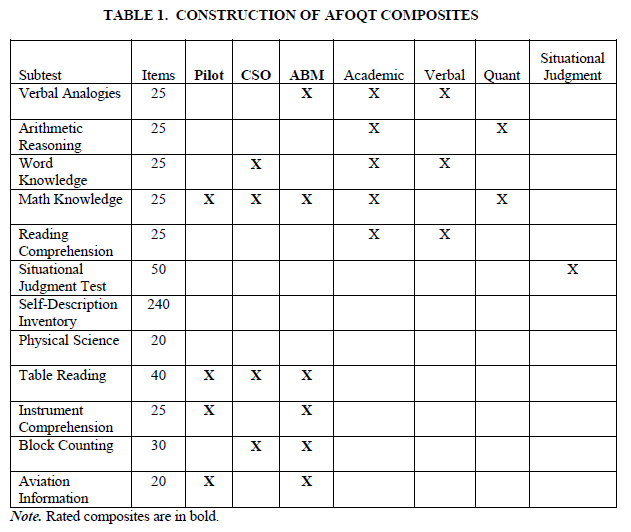
Start with the Verbal and Quantitative minimums, then move to the subtests behind any rated composite you want. We found no Air Force percentage weights, so this split rests on item counts, time limits and an undated composite chart on the Rutgers page. That chart lists 50 Situational Judgment items where Pearson lists 16, plus a Situational Judgment composite that Pearson does not list, so check it with your detachment.
| Composite | Subtests in the Rutgers chart |
|---|---|
| Verbal | Verbal Analogies, Word Knowledge, Reading Comprehension |
| Quantitative | Arithmetic Reasoning, Math Knowledge |
| Academic Aptitude | Verbal Analogies, Arithmetic Reasoning, Word Knowledge, Math Knowledge, Reading Comprehension |
| Pilot | Math Knowledge, Table Reading, Instrument Comprehension, Aviation Information |
| CSO | Word Knowledge, Math Knowledge, Table Reading, Block Counting |
| ABM | Verbal Analogies, Math Knowledge, Table Reading, Instrument Comprehension, Block Counting, Aviation Information |
Here is a starting split. The percentages are our judgment, not an Air Force figure, so change them once you have a baseline.
| Study group | No rated goal | Rated goal |
|---|---|---|
| Arithmetic Reasoning, Math Knowledge | 40% | 25% |
| Verbal Analogies, Word Knowledge, Reading Comprehension | 40% | 25% |
| Table Reading, Instrument Comprehension, Block Counting, Aviation Information | 10% | 40% |
| Situational Judgment | 5% | 5% |
| Physical Science | 5% | 5% |
The chart also helps you choose within those groups. Math Knowledge feeds Quantitative, Academic Aptitude and all three rated composites, so it is worth extra time. Table Reading feeds all three rated composites too. Pilot candidates should favor Instrument Comprehension and Aviation Information, and CSO candidates Block Counting and Word Knowledge. Physical Science feeds no composite in the chart, so keep it brief, but it is still on the test.
How to use an AFOQT practice test
Use practice tests to measure your speed on each subtest as well as your total. Time each set at the seconds per item above, then move study hours toward the groups furthest from your target.
The 20 free AFOQT practice questions on this page are newly written and are not real exam questions. They cover 9 of the 11 graded subtests. Instrument Comprehension and Block Counting are left out because they normally depend on figures. The mix follows item counts because we found no official weights. For more timed work, VirtuePrep has 1,000 AFOQT questions, with an explanation for every answer.
If you are choosing an AFOQT study guide, check it against the table above first. It should list the same 12 subtests, 516 items and 16 Situational Judgment items. Some sites still give 550 items, which does not match Pearson's current list.
OATTS is free familiarization software that works offline. Its site calls it the only official, Air Force endorsed platform for AFOQT and TBAS familiarization, and Montana State's detachment describes it the same way. Rutgers also links Air Force approved preparation materials on an AFPC page, which we could not open.
Cadets should also know the study rules. Rutgers says anyone who has never tested may study only with others who have never tested, and Montana State says cadets who have tested may not join group study with those who have not. Rutgers adds that outside materials must be chosen without knowledge of actual test content.
If you are comparing paths, see the ASVAB, FSOT and GRE pages, or browse all exams.
20 free AFOQT practice questions
Answer each one yourself, then open the answer. No account needed. These are study questions, not real exam questions.
-
CARTOGRAPHER is to MAP as LEXICOGRAPHER is to:
- grammar
- dictionary
- linguist
- library
Show answer
Answer: B. A cartographer makes maps, and a lexicographer writes or compiles dictionaries. The relationship is maker to thing made, so the answer must be the work a lexicographer produces.
Source: Wiktionary: lexicographer
-
FRUGAL is to SQUANDER as CANDID is to:
- reveal
- trust
- conceal
- admire
Show answer
Answer: C. A frugal person avoids waste, so squandering is the opposite of that trait. A candid person is open and holds nothing back, so concealing is the behavior that trait rules out. Revealing fits the trait itself, which breaks the pattern.
Source: Wiktionary: candid
-
A squadron's monthly fuel allotment of 2,400 gallons is cut by 15 percent. The next month, the reduced amount is raised by 10 percent. How many gallons is the allotment after both changes?
- 2,040
- 2,160
- 2,244
- 2,280
Show answer
Answer: C. After the cut, the allotment is 2,400 x 0.85 = 2,040 gallons. The 10 percent increase applies to that lower amount: 2,040 x 1.10 = 2,244 gallons. You cannot simply net the two percentages, because they apply to different starting amounts.
Source: Wolfram MathWorld: Percent
-
An engineer is marking a 2.4 km runway edge. A light goes at each end of the edge and every 150 m in between. How many lights does that edge need?
- 14
- 15
- 16
- 17
Show answer
Answer: D. The prefix kilo means 1,000, so the edge is 2,400 m long. That gives 2,400 / 150 = 16 equal gaps. With a light at both ends, there is one more light than there are gaps, so 17 lights.
Source: NIST: Metric SI prefixes
-
Before the morning update, the flight commander asks that each section's report be terse. Terse most nearly means:
- brief
- formal
- accurate
- printed
Show answer
Answer: A. Terse means using few words and getting straight to the point, so brief is the closest match.
Source: Wiktionary: terse
-
A safety review finds that the revised duty roster would exacerbate crew fatigue. Exacerbate most nearly means:
- measure
- worsen
- disguise
- ease
Show answer
Answer: B. To exacerbate a problem is to make it worse, so the review expects fatigue to increase under the new roster.
Source: Wiktionary: exacerbate
-
A rectangular parking apron has an area of 72 square units, and its length is 6 units greater than its width. What is its perimeter in units?
- 18
- 24
- 36
- 72
Show answer
Answer: C. Let the width be w, so w(w + 6) = 72, which is the quadratic w^2 + 6w = 72. Its roots are 6 and negative 12, and only 6 can be a width. The length is 12, so the perimeter is 2(6 + 12) = 36.
-
A survey team drives 24 km due east from a radar site, then 10 km due north. What is the straight-line distance from the team back to the site, in km?
- 22
- 26
- 28
- 34
Show answer
Answer: B. East and north meet at a right angle, so the two legs and the straight-line distance form a right triangle. By the Pythagorean theorem, the distance squared is 24^2 + 10^2 = 576 + 100 = 676, and the square root of 676 is 26.
-
Passage: A thunderstorm cell passes through three stages. First, warm, moist air rises in updrafts and a cumulus cloud grows upward. Next, updrafts and downdrafts exist side by side, and the storm is at its most dangerous, with possible tornadoes, large hail, damaging winds and flash flooding. Finally, a downdraft cuts off the updraft, the warm, moist air stops reaching the storm, and the storm fades, sometimes leaving light rain and weak winds. For a duty forecaster using this passage, which observation best suggests a cell has passed its most dangerous stage?
- Strong updrafts and downdrafts are present together
- The cloud is still growing upward on rising moist air
- Large hail and damaging winds are reported below the cloud
- A downdraft has cut off the updraft and only light rain remains
Show answer
Answer: D. The passage places the greatest danger in the stage where updrafts and downdrafts exist together. Once a downdraft has cut off the updraft and only light rain remains, the cell is in what the passage describes as the final, fading stage.
-
Passage: On December 17, 1903, at Kill Devil Hills, North Carolina, the Wright brothers flew into a 27-mph wind. They had expected to cruise at 30 to 35 mph, so the headwind sharply reduced their speed over the ground. On the first flight, Orville Wright covered about 120 feet at a ground speed of 6.8 mph, although his airspeed was 34 mph. The brothers took turns, and the fourth flight, by Wilbur, covered 852 feet in 59 seconds. A gust then rolled the aircraft over and damaged it, which ended their flying for the season. Which conclusion is best supported by the passage?
- The headwind cut how far the first flight traveled over the ground
- The first flight was the longest of the four flown that day
- The aircraft failed to reach its expected speed through the air
- The brothers stopped for the season because daylight ran out
Show answer
Answer: A. The passage says the headwind reduced speed over the ground, and the first flight covered about 120 feet at only 6.8 mph over the ground. It also gives 852 feet for the fourth flight, an airspeed of 34 mph within the expected 30 to 35 mph, and a gust as the reason flying ended.
-
You are a new lieutenant. An hour before a readiness report is due, you find an error in a figure your commander has already signed, and the error makes the unit look better than it is. What is the most effective action?
- Send the report on time and correct the figure in next month's report
- Tell the commander now and ask to send a corrected report, even if it goes out late
- Change the figure yourself so the signed report goes out correct and on time
- Ask another lieutenant whether a difference this size is worth raising
Show answer
Answer: B. Integrity first is an Air Force core value. The commander signed the report and is accountable for it, so the commander needs to know about the error before it goes out, and the record needs to be correct. Telling the commander protects the accuracy of the report and the commander's authority over it. This key is a judgment from that value, not an Air Force scoring rule.
-
A normally reliable member of your section has missed two deadlines this month, and teammates have started covering for that person. You have seen no earlier performance problems. What is the most effective first step?
- Meet privately, ask what has changed, restate the standard and agree on a plan
- Move the person's tasks to the teammates who are already covering them
- Bring up the missed deadlines at the next section meeting as a lesson for everyone
- Send the commander a written account of the missed deadlines before speaking to the person
Show answer
Answer: A. A first step should find the cause and keep the standard in place. A private conversation does both, respects the person and gives them a chance to recover. It fits the Air Force Academy's description of a leader of character as someone who lifts others and raises performance. This key is a judgment from that description, not an Air Force scoring rule.
-
A sealed, flexible container holds 2 cubic meters of gas at 100 kPa. It is moved to a chamber where the outside pressure, and so the gas pressure, drops to 50 kPa. The temperature does not change. What is the new volume of the gas, in cubic meters?
- 1
- 2
- 4
- 8
Show answer
Answer: C. By Boyle's law, pressure times volume stays constant for a confined gas at constant temperature. Here pV = 100 x 2 = 200, so at 50 kPa the volume is 200 / 50 = 4 cubic meters.
Source: NASA Glenn: Boyle's Law
-
A net force from a tug gives a 2,000 kg cargo cart an acceleration of 1.5 m/s^2. The same net force is then applied to a 3,000 kg cart. What is the second cart's acceleration, in m/s^2?
- 0.5
- 1.0
- 1.5
- 2.25
Show answer
Answer: B. From F = m x a, the net force is 2,000 x 1.5 = 3,000 N. With the same force on the heavier cart, a = 3,000 / 3,000 = 1.0 m/s^2. The same force on more mass gives less acceleration.
-
A made-up practice chart gives takeoff distance in feet. Weight 12,000 lb: 10 C = 1,850, 20 C = 2,010, 30 C = 2,190. Weight 14,000 lb: 10 C = 2,240, 20 C = 2,430, 30 C = 2,650. Weight 16,000 lb: 10 C = 2,680, 20 C = 2,910, 30 C = 3,170. What is the distance for 14,000 lb at 30 C?
- 2,650
- 2,430
- 2,910
- 2,190
Show answer
Answer: A. Find the 14,000 lb row, then read across to the 30 C value, which is 2,650 feet.
-
A practice grid is read by X and Y value. Row Y = +1: X = -1 is 37, X = 0 is 41, X = +1 is 46. Row Y = 0: X = -1 is 33, X = 0 is 38, X = +1 is 44. Row Y = -1: X = -1 is 29, X = 0 is 35, X = +1 is 40. What value is at X = +1, Y = 0?
- 35
- 38
- 41
- 44
Show answer
Answer: D. Go to the row where Y = 0, then to the entry for X = +1, which is 44. Swapping the two coordinates would land on 41.
-
A made-up practice chart gives fuel used in gallons. Leg 1: Aircraft A 310, Aircraft B 275, Aircraft C 340. Leg 2: Aircraft A 295, Aircraft B 330, Aircraft C 260. Leg 3: Aircraft A 350, Aircraft B 305, Aircraft C 315. A planner wants the single lowest entry in the chart. Which is it?
- Aircraft A on Leg 2
- Aircraft B on Leg 1
- Aircraft C on Leg 2
- Aircraft B on Leg 3
Show answer
Answer: C. The smallest number in the chart is 260 gallons, which is Aircraft C on Leg 2. The next lowest entry is 275 gallons.
-
A made-up practice schedule lists start times. Monday: Crew 1 at 0700, Crew 2 at 0930, Crew 3 at 1200. Tuesday: Crew 1 at 0800, Crew 2 at 1030, Crew 3 at 1300. Wednesday: Crew 1 at 0630, Crew 2 at 0900, Crew 3 at 1130. How many minutes later does Crew 2 start on Tuesday than on Wednesday?
- 60
- 90
- 120
- 150
Show answer
Answer: B. Crew 2 starts at 1030 on Tuesday and at 0900 on Wednesday. The gap is 1 hour 30 minutes, which is 90 minutes.
-
A pilot in level flight wants to turn to a new heading along a smooth, curved path. Which control input starts the standard banking turn?
- Deflect the elevators to raise the nose
- Deflect the rudder while holding the wings level
- Extend the flaps and slats
- Deflect the ailerons to roll toward the new heading
Show answer
Answer: D. NASA Glenn explains that an airplane turns by rolling toward the way it wants to go, and that deflecting the ailerons causes roll. The tilted wings then produce a gradual curved flight path.
Source: NASA Glenn: Airplane parts and function, guided tour
-
An aircraft has just landed, and the crew wants to reduce lift and add drag as it slows on the runway. Which wing devices do that?
- Spoilers
- Flaps
- Slats
- Ailerons
Show answer
Answer: A. NASA Glenn describes spoilers as devices that decrease lift and increase drag during landing. Flaps and slats increase both lift and drag, and ailerons roll the aircraft.
Source: NASA Glenn: Airplane parts and function, guided tour
What you get with VirtuePrep AFOQT prep
- 1,000 practice questions built around the topics the AFOQT tests.
- An explanation for every answer, so each mistake teaches you something.
- Stats and history that show your weakest topics first.
- Web, iPhone and Android, so you can study wherever you have ten minutes.
AFOQT practice test questions people ask
What is the minimum passing score for the AFOQT?
What are the AFOQT minimum scores for pilot?
What are the minimum AFOQT scores to commission?
Does the AFOQT cost money?
How do you get AFOQT scores?
What should you study for the AFOQT?
How long does it take to study for the AFOQT?
How hard is it to pass the AFOQT?
What should you bring to the AFOQT?
Where can I take the AFOQT near me?
What is the difference between the AFOQT and the ASVAB?
Sources
All pages opened on November 7, 2026.
- Pearson VUE: AFOQT: sponsor, purpose, format, subtests, fee, attempts, scores, ID, account terms, accommodations link, test centers (last updated August 6, 2026)
- Rutgers AFROTC Detachment 485: AFOQT: minimum scores and DAFMAN 36-2664 citation, percentiles, superscoring, retests, third-attempt deadline, study rules (page marked current as of July 2026, section marked November 2025)
- Rutgers chart of rated minimums (undated)
- Rutgers chart of AFOQT composites (undated)
- Montana State AFROTC Detachment 450: AFOQT: who needs passing scores, timeline, Academic Aptitude in POC selection, preparation time, retests, study rules, PCSM, OATTS (updated June 2026)
- USF AFROTC Detachment 158: testing: electronic format, test locations, attempts, retests, what retesters bring (no update date shown)
- OATTS: free familiarization software
- Official ASVAB site: what the ASVAB is

VirtuePrep is not affiliated with or endorsed by the organisation that runs the AFOQT. Exam names are trademarks of their owners. Practice questions are written for study and are not real exam questions. Page updated 2026-11-07.
More Military Services exams
Start your AFOQT prep today
Answer your first question in under a minute. Free to try.